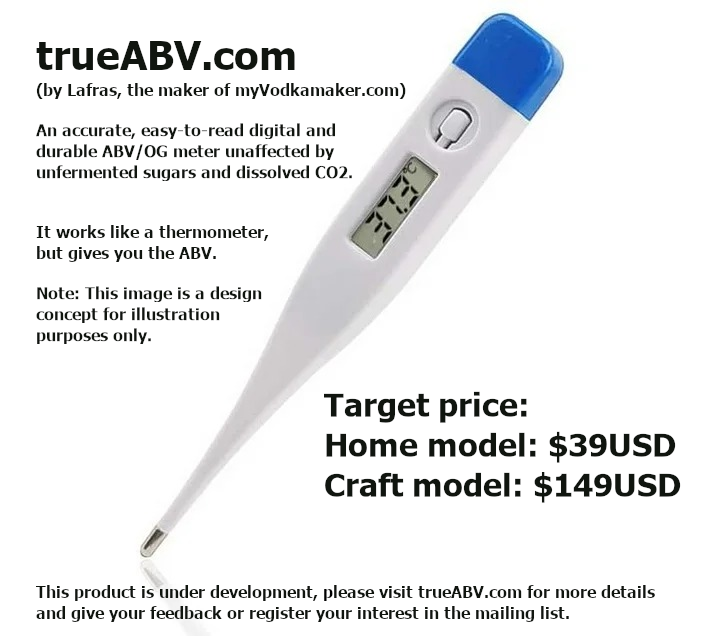
An accurate, easy to read, digital, and durable ABV/OG meter unaffected by unfermentable sugars or dissolved CO₂.
Note) This a planned product and is not available yet. - Although I have my patent pending sensor working well on the test bench, I am only now starting with the actual product development. These are my ideas for the end product, but I would like to get community feedback on what you think and would like to see in the ideal ABV meter. I would love for you to hit the "Comment and Register your interest in the mailing list" button and tell me your thoughts (positive or negative - be brutal)
The product ideas:
* Measure wash, mash, beer, wine or spirit ABV directly.
* Works just like a digital thermometer.
* No need to degas your sample.
* No need to even take a separate sample.
* Measure your actual and trueABV without knowing the Original Gravity or degassing your sample.
* Measure the trueABV of sweetened cocktails.
* Measure your Original Gravity.
ABV Range 0% to 99.9%.
OG Range 1.040 to 1.300.
Temperature Range 0'C to 50'C.
Why:
1) trueABV is digital, direct, fast and easy to read.
2) Many novice home brewers or distillers don't know you can't directly measure the ABV in a wash, mash, beer or wine accurately with an alcometer, but now everyone should know you can with the trueABV meter.
2) Carry one in your pocket and check if your bar dilutes their overcharged Rum and Coke. See how much alcohol is actually in your glass.
3) A density based alcohol meter's reading is severely affected by the remaining sugars in the solution, because density is more sensitive to sugar than ethanol, so glass alcohol meter can only really read the ABV if there are no unfermented sugars. For example: a 10% ABV spirit with 33g/L sugar (sg 1.012) added will read 1% abv on an alcometer; but trueABV will read 10%. Most Colas and Juices have more than 80g/L sugar. A typical all-grain mash can have 10 to 40 g/L of unfermentable sugars left.
It is simply not possible to use a density based meter to determine the correct final ABV because even small amounts of unfermented sugar affect the density significantly.
4) trueABV does not use a density measurement, it uses a patent pending method that measures the ABV but is almost unaffected by even significant amounts of sugar.
Why not?
You may prefer traditional old-school tools and methods.
Planned Models:
Home $39
Measures +-0.5% ABV accuracy and displays to 0.1% (same as the EasyDens).
(does not measure OG)
Measures +-0.2°C temperature accuracy and displays to 0.1 °C.
3.5 digit LCD display(188.8) + Icons.
2 buttons.
CR1212 coin cell.
Brewer $89
Measures +-0.5% ABV accuracy and displays to 0.1% (same as the EasyDens).
Measures +-1.005 OG accuracy and displays to 0.001.
Measures +-0.2°C temperature accuracy and displays to 0.1 °C.
Larger Graphic OLED display.
4 buttons.
Logging / Recording.
SD card slot for logging to spreadsheets.
Bluetooth and an app for logging to spreadsheets.
Tracking of multiple simultaneous ferments in progress.
Real time clock.
Change language and regional settings.
CR2020 coin cell.
Craft $149
Same features as the Brewer plus:
Factory Calibrated, measures +-0.05% ABV and displays to 0.1% ABV accuracy.
Measures +-1.001 OG accuracy and displays to 0.001.
Measures +-0.1°C temperature accuracy and displays to 0.1 °C.
Parrot $299
All the features of the Craft model plus:
It is a integrated "Parrot" design.
10mL volume with minimal smearing.
Logging every 5 seconds.
Time, ABV, Temperature, Flow.
Alarms at a certain ABV.
Alarms at a certain temperature.
Alarms at a certain flow rate.
Wifi connectivity.
Speaker read aloud the ABV or sound alarms.
Alarms/ Logging and sending to your phone.
Large rechargeable battery with USB charging port.
Pro $999+
All the features of the Craft model plus:
Independent Certified accuracy to applicable standards per industry.
3.5" Touch screen display.
NFC reader for automatic logging of measurements to tagged barrels.
Detachable/Extendable Probe to do direct in barrel reading without extracting a sample.
Large rechargeable battery with USB charging port.
Pro Barrel $299
Factory Calibrated, measures to 0.1% accuracy.
A "Pill" dropped into a fermenter or ageing barrel that logs and continuously reports the temperature, ABV and movement via WiFi.
Detailed Difference:
Traditionally you measure the effect of the sugar on the density via a standardized gravity reading (SG).
As the ferment proceeds you are mostly measuring the reduction of the sugars not the increase in ABV.
At about SG 1.012 only a small amount of the sugars remain and the most of the ethanol has been produced but is still not measurable due to the dominance of the sugar.
Once the ferment is down to below 1.000 you are now measuring mostly the effect of the alcohol, but the trace amount of remaining sugars still have a big effect.
You cannot read ABV directly and accurately even if there is even a tiny bit of sugar.
TrueABV works the opposite way, a OG of 1.070 sugar affects the trueABV sensor by only 2%.
So before you start the ferment, you can take an accurate OG reading because you know there is no ethanol.
As the ferment proceeds, by the time it has dropped to 1.060 the trueABV reading is dominated by the ABV.
By the time you are down to 1.030 sugar you are reading a near true ABV on the trueABV meter.
By the time you are down to 1.012 sugar the remaining unfermented sugars have no measurable effect on the trueABV reading.
You determine the end of the ferment by getting relative stable readings of ABV down to 0.1%.
Practical difference:
The traditional method uses at least 2 instruments for brewing and another for distilling, and a fourth if sugar is added after distillation.
To measure ABV if OG is unknown or if sugar remains or is added after fermentation or is added after distillation you have to do an accurate hydrometer and refractometer reading, then you can calculate the ABV with software of an App.
(Thermometer, hydrometer, alcometer, and refractometer)
The true ABV method uses one digital instrument to do all those functions in one go.
Needs about a 10mL sample vs 80ml on a glass instrument.
FAQ:
When will it be available for order?
First production units of the home model will be about June 2025, with the Craft version about September. Please click the "Comment and register interest" button if you are interested in the first production run, or if you would like to join the Beta testing program.
How does trueABV-home compare to "EasyDens by Anton Paar"
They have about the same measuring accuracy. (+-0.5%)
The trueABV is 10x more affordable than the EasyDens.
The trueABV can read trueABV of beer/wine directly while the EasyDens needs a SmartRef to do this.
The trueABV is much more portable, quick and easy to use.
The trueABV has a display and you just read it, the EasyDens requires a phone to get your reading.
The EasyDens is fragile and prone to breaking if dropped, the trueABV is not.
The EasyDens needs a sample to be taken with a Syringe, degassed and injected into the EasyDens, With the trueABV just dip in the tip like with a thermometer.
The EasyDens needs a whole cleaning procedure after every use with warm ultra-pure, bi-distilled or deionized water. trueABV just wipes clean.
How does trueABV-craft compare to "EasyDens by Anton Paar"
The trueABV-craft has all the benefits of the trueABV-home plus:
The trueABV Graphic OLED displays a lot more information at your finger tips.
The trueABV has higher accuracy(+-0.05%), more comparable to the "Anton Paar SNAP 51" that costs $3000+.
Both have Bluetooth connectivity
The EasyDens app is more mature and has more features than the trueABV app will have when launched.
How does trueABV compare to digital alcohol refractometers and digital sugar refractometers?
For Beer ABV you need two instruments, two accurate readings and a calculation to get a dubious result.
Spirit refractometers have limited range, usually only up to 80%, the trueABV measures up to 100%.
The trueABV is much more portable, quick and easy to use.
The trueABV has a display and you just read it, no need for taking samples, reading and calculating.
How does trueABV compare to glass alcometers and hydrometers?
Glass instruments are prone to breaking if slightly mishandled, the trueABV is not.
Glass instruments require a vessel of some sort to float in, With the trueABV just dip in the tip like with a thermometer.
How does trueABV-home compare to trueABV-craft?
Home is a manual instrument for taking readings.
Craft has higher precision.
Craft has a clear large OLED display.
Craft can log to a SD card.
Craft displays more information and can track multiple ferment's progress or track multiple barrels ageing (remembers the readings).
Craft can log and display on a phone app.
Why does the trueABV-home measure -0.5% ABV accuracy but display to 0.1%?
This is useful at the end of a fermentation to take relative measurements to track if there is still any alcohol being produced.
How can trueABV take an Original Gravity reading but not a Final Gravity reading?
trueABV does not measure Gravity (Density) and it is only slightly affected by high concentrations of sugar.
So if there is no ethanol present trueABV can measure the high concentrations of sugar and calculate the Original Gravity.